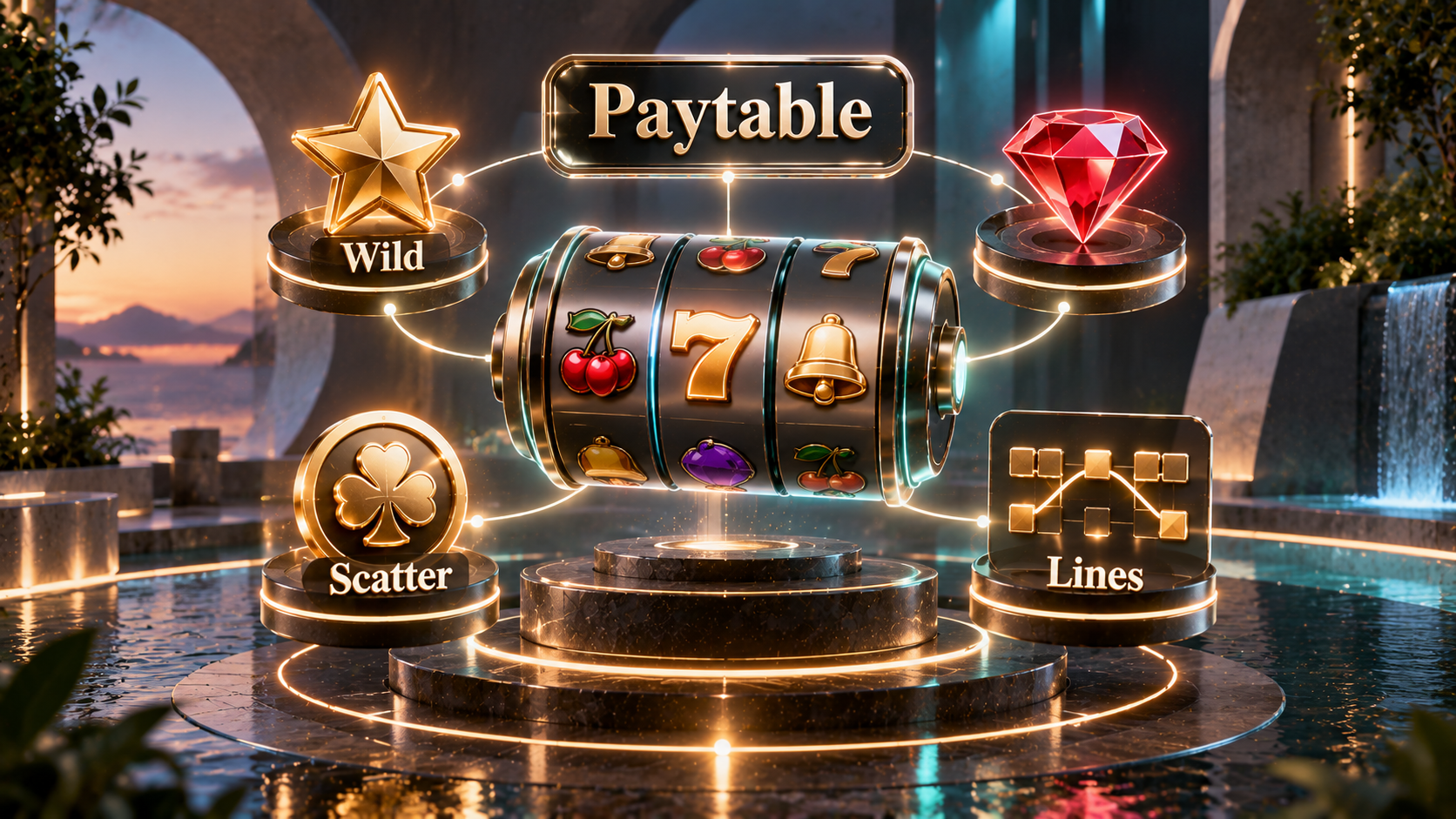
A paytable is the instruction manual for a pokie, and reading it before depositing or selecting a stake is where the licensing, encryption and fair play standards of the operator give way to the rules of the individual game. It shows which symbols pay, how wins are formed, what triggers a feature and what conditions apply to jackpots or bonus rounds. Many players open a pokie and start spinning after looking only at the artwork and headline jackpot. A short review of the information screen changes that entirely.
Start with the bet display
Before studying symbols, identify how the game presents the stake. Some pokies show a single total bet. Others divide the amount into coin value, coins per line and number of active paylines. These systems can produce the same total wager through different settings.
A practical example: 20 active lines at 5 cents per line produce a $1 total bet. Raising the coin value to 10 cents on the same 20 lines moves the total to $2. If the player adjusts coin value without checking the line count, the total stake can shift faster than expected. The final bet shown beside the spin button is the number to confirm before each session.
The information screen may also list minimum and maximum stakes. A player should check the total again after switching games because each title can use different defaults.
Match symbols to their actual values
The paytable usually arranges symbols from lower to higher value. Card ranks, fruit or simple icons often pay less than characters and themed objects. The table may show returns for three, four and five matching symbols.
A value such as “50” may mean 50 coins or 50 times a line bet, not $50. The game rules explain the unit. Selecting a different stake may update the displayed cash values automatically, which makes comparison easier.
A large symbol prize may also require a full five-symbol combination. Three matching symbols might pay far less. Looking only at the highest number can create the wrong impression of how often that prize can occur.

Check how paylines create wins
The method used to form wins varies across pokies formats. Understanding which one applies shapes how the paytable is read.
| Win format | How wins form | Typical display |
| Fixed paylines | Matching symbols on set line paths, left to right | Line diagram in help screen |
| Selectable paylines | Player chooses active lines; fewer lines means fewer ways to win | Line count shown beside bet |
| Ways to win | Matching symbols on consecutive reels, any position | e.g. 243 ways, 1,024 ways |
| Cluster pays | Enough matching symbols touching in required shape | Cluster size stated in rules |
| Megaways | Symbol count per reel changes each spin; combinations vary | Max ways shown in title |
The game description should make the method explicit. Players should confirm:
- Where a winning combination must begin.
- If symbols must sit on adjacent reels.
- If paylines are fixed or selectable.
- If several wins can be paid on one spin.
- How overlapping combinations are treated.
This section of the rules explains why a group of matching symbols may look close to a win but receive no payment.
Wilds and scatters follow separate rules
A wild commonly substitutes for standard paying symbols, though it may leave scatters, bonus symbols or jackpot icons outside its substitution range. Some wilds expand across a reel, move between spins, carry a multiplier or remain in place during a feature.
The paytable should state if the wild has its own payout and how two multipliers combine. A 2x wild and a 3x wild might add to 5x in one game or multiply to 6x in another.
Scatters often pay without following a line. They may award a prize anywhere on the reels or activate free spins after a required number lands. The minimum count and eligible reel positions should be listed. A scatter visible on only certain reels has a smaller range of possible combinations than one that appears across all reels.
Read the feature trigger from start to finish
A feature description should show how the round begins, how many spins or selections it provides and if retriggers are possible. It may also explain multipliers, expanding reels, collected symbols or prize ladders.
Some games use a fixed free-spin award, while others increase the quantity based on the trigger count. A retrigger may require the same number of scatters as the original feature or a different combination.
If a buy-feature option is available, the paytable should show its cost and the feature it opens. Paying for direct entry changes the amount risked on that action.
Look for jackpot eligibility conditions
A pokie can display a jackpot meter even when only certain spins qualify for the top prize. The rules may require a minimum stake, a specific side bet or a particular symbol combination. Other jackpots are available at every permitted stake, with prize values proportional to the wager.
The paytable should distinguish fixed jackpots from progressive ones. A fixed jackpot stays at a stated amount. A progressive jackpot grows as eligible wagers contribute to the prize pool and resets after a win.
Players should also check if the jackpot is local to one game, shared across several titles or linked across multiple casinos. This affects how quickly the displayed total may move.
Maximum win and RTP need context
The maximum-win figure is usually expressed as a multiple of the stake, such as 5,000x or 10,000x. It describes the largest permitted result under the game rules. The route to that amount may depend on a rare feature sequence or a capped multiplier.
RTP describes the theoretical return across a very large sample of play. Volatility indicates how uneven the results may feel. A high maximum win can coexist with long quiet stretches. A lower maximum may appear in a game that pays smaller amounts more regularly. These details help choose a game that suits the planned budget and session length.
Take a final screenshot or note
Once the rules are understood, record the total stake, feature trigger and any jackpot eligibility condition. A screenshot of the information page can be useful if the game later updates or if a result needs to be discussed with support.
The paytable should remain accessible during play. If a symbol combination looks unfamiliar, pause and check it. Game history can then confirm the symbols, wager and amount paid.
Reading a paytable takes only a few minutes, yet it changes a pokie from a collection of animations into a defined set of rules. Australian players can see exactly what their stake activates, how combinations are counted and which features carry special conditions. That information supports a more deliberate choice before real money is placed.
No Responses